Before a ball was kicked, our pre-tournament forecast made Messi a 53.4% shot to break the all-time World Cup goals record. Two games in, he’s done it. Five goals from his opening pair have carried him to 18 career World Cup goals, clear of Miroslav Klose’s 16. One record is gone, roughly on schedule. The question now is what he does with the rest of the tournament, because there’s a bigger one up the road that nobody has touched in nearly seventy years.
One record’s already gone
His fourth goal of the tournament took him past Klose; his fifth made the new record 18. He cleared it early, which changes what the rest of Argentina’s run is about. Every goal from here pads a mark of his own instead of chasing someone else’s.
The next record: Fontaine’s 13
The single-tournament record is a different animal. Just Fontaine scored 13 for France at the 1958 World Cup, all in six games, and in the 68 years since, only Gerd Müller has come close, with 10 in 1970. Messi is on 5. He needs 8 more to draw level. How hard that is depends on how many games Argentina have left to play.
| Argentina games left | Goals/game Messi needs to reach 13 |
|---|---|
| 4 | 2.00 |
| 5 | 1.60 |
| 6 | 1.33 |
The chart below shows both players by match: Fontaine’s gold line up to 13, Messi’s blue one at 5 so far, and the thin paths fanning out across every game Argentina have left.
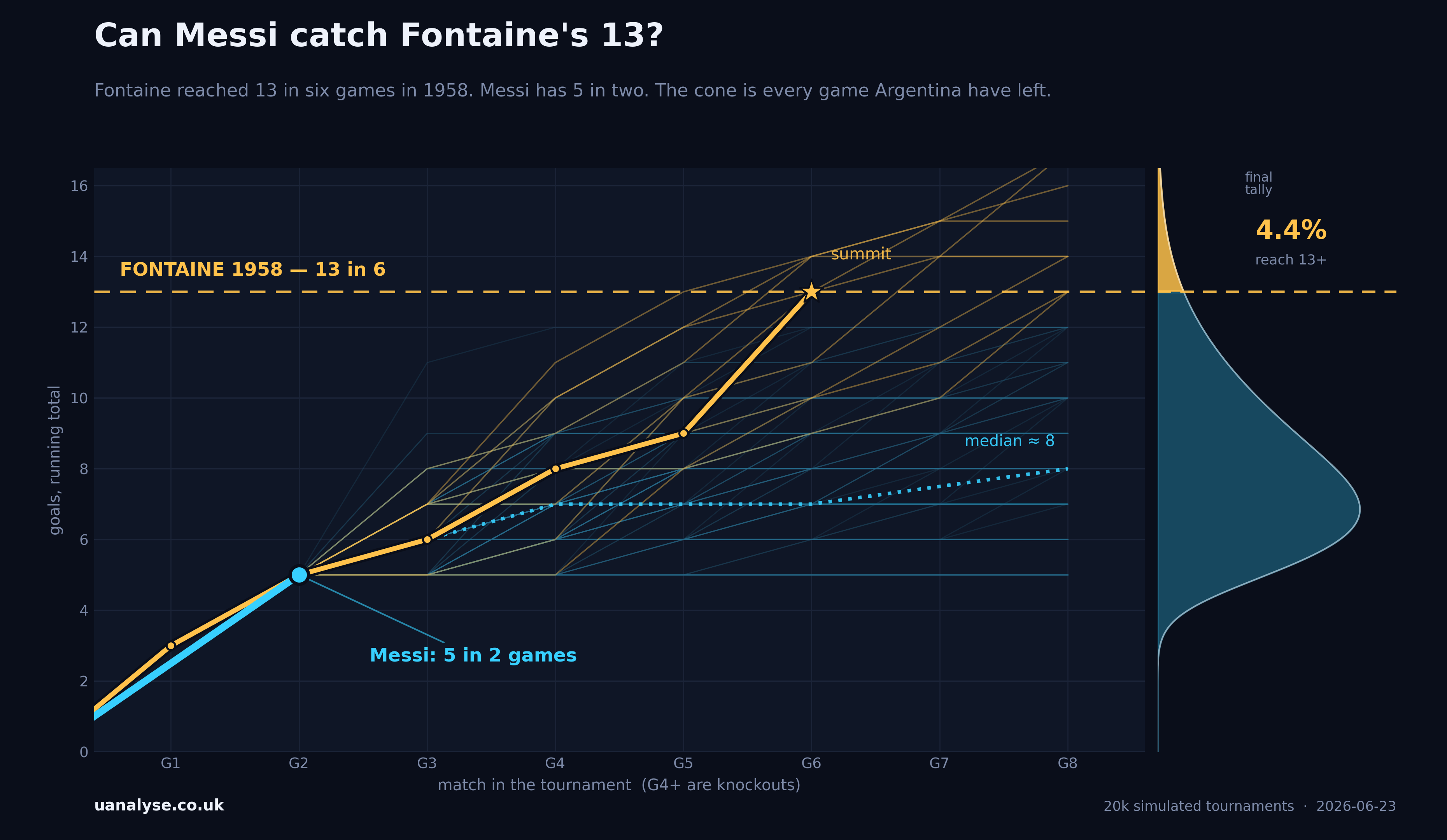
If you’ve not seen one of these before: the chart stacks up goals as the tournament goes on. Each line rises by a goal every time that player scores, so a steeper line means a hotter run and a flat stretch means a quiet game or two. The left edge is the start of the World Cup, the right edge is the final.
The model gives him a 4.4% chance of reaching 13 or more, and 2.0% of going past it outright. His median finish is 8, his 90th-percentile finish around 11, and the full distribution only tips over 13 in that thin gold tail on the right. So can he catch Fontaine? It may be the most serious live chase of that record in decades, and it’s still a long shot.
How far Argentina go decides it
Goals need games. Messi only gets more shots at 13 if Argentina keep winning, and the model likes their chances: it projects them to win Group J and rates them the tournament favourite, a 15.3% title chance. Here is the road it expects them to take, round by round.
Every round they survive is one more match for Messi. A finalist plays eight games; a team that exits in the group stage plays three, and a round-of-32 exit plays four. That gap is what the cone in the chart is drawing, so catching Fontaine rides on Argentina’s run as much as on Messi’s finishing.
He’s outrunning the model. Should we trust it?
There’s a fair challenge to all this. Before the tournament the model had Messi down for about 4 goals across the whole World Cup, a rate near 0.70 a game. He’s scoring at 2.5. If the model just shrugged and stuck to its prior, you’d be right to ignore it.
It doesn’t. The forecast banks all five goals and then lifts his rate for the games still to come to about 1.52 a game, roughly 2.2× what it assumed pre-tournament. To be precise about that 1.52: it’s goals scored, not xG, and it’s his projected remaining goals divided by Argentina’s projected remaining games, averaged across every simulation, the early exits included. A hot start moves the number, and it moves it a lot. What the model won’t do is assume he keeps banging in two and a half a game for another six matches, because almost nobody ever has. That’s regression to the mean doing its job. Take his current pace and run it forward naively and he’d sail past Fontaine inside four more games. The model puts the realistic version of that at 4.4%. The early burst is real and it’s already counted, and the cooling is just as real.
Mbappé, right behind him
| Player | 2026 goals | Career WC goals | Golden Boot chance | Reach 13+ |
|---|---|---|---|---|
| Messi | 5 | 18 | 59.6% | 4.4% |
| Mbappé | 4 | 16 | 16.7% | 0.8% |
Kylian Mbappé has 4 in his two games, which puts him on 16 career World Cup goals: level with the old Klose record and 2 behind the new one Messi just set. He’s the obvious heir, more than a decade younger, with tournaments ahead of him to chase whatever number Messi finishes on this summer. His own shot at Fontaine’s 13 this year is a much slimmer 0.8%, but the longer game is his. That gap is wider than their one-goal difference looks: Mbappé needs nine more to Messi’s eight, France project a shorter run than the favourites Argentina, and Messi is scoring at a higher clip. The three compound. Two of the best of their generation are in the record books at once, one rewriting it and one waiting his turn.
One record is already history. Fontaine’s has stood since 1958, and for the first time in decades someone is scoring fast enough to make it nervous. We’ll keep updating this as the games land. Follow the live Golden Boot board →